Exercising During Your Period: Syncing Your Menstrual Cycle With Your Exercise Routine

Medically reviewed by
Dr. IkejiLast reviewed: 02 Jul 2025
Your menstrual cycle can affect your energy levels, mood, and physical performance. Many people notice that they feel stronger, faster, and more confident, or more sluggish, depending on where they are in their cycle. Syncing your workouts with your menstrual cycle can help you optimise your performance, improve recovery time, and manage discomfort by working with your natural hormonal fluctuations, rather than against them.
Here, we explore the menstrual cycle phases, the best activities for each phase, and bust some of the common misconceptions.
What's on This Page?
- 1. Different phases of the menstrual cycle
- 2. How hormones and the menstrual cycle affect your workouts
- 3. Best exercises for each phase of your menstrual cycle
- 4. Benefits of syncing your workouts with your cycle
- 5. Common misconceptions about exercising on your period
- 6. Tips for exercising on your period
- 7. Summary
Different phases of the menstrual cycle
To understand how your period affects exercise, it’s important to understand the menstrual cycle. The menstrual cycle is divided into 4 distinct phases:
Menstrual phase (days 1 to 5)
The menstrual phase is when your period begins. A period is the shedding of your womb lining and usually lasts up to 5 days, but can vary from person to person, for example some people also experience it for 3 days or up to 7 days.
During this time, oestrogen and progesterone levels are low, making you feel tired and sluggish, and it’s common to experience symptoms such as cramping alongside bleeding.
Follicular phase (days 6 to 14)
After your period, oestrogen levels start to rise, and follicles (small, fluid-filled sacs that contain an immature egg) start to develop on the ovaries.
One follicle will become dominant, and within this one, a mature egg will grow. At the same time, the womb lining thickens in preparation for an egg being fertilised.
Ovulation (around day 14)
Ovulation is the release of an egg from the ovaries, and although day 14 is the average day of ovulation, it can happen any time between day 7 and 22 in a normal cycle. There is a high likelihood of pregnancy if you have unprotected sex during this phase.
Luteal phase
After ovulation has occurred, the empty follicle transforms into a structure called the corpus luteum, which produces progesterone and a small amount of oestrogen to maintain a thickened womb lining. If pregnancy happens, the corpus luteum will continue to produce hormones to maintain pregnancy. If it does not occur, it will shrink, and progesterone levels will drop, leading to a period and the start of a new menstrual cycle.
The luteal phase usually lasts for 12 to 14 days and can result in symptoms of premenstrual syndrome (PMS), like mood changes and other physical signs.
How hormones and the menstrual cycle affect your workouts
Hormonal changes during the menstrual cycle can impact your workout performance and how your body responds to exercise. Different hormones have varying roles and influences on our physical performance. For example:
- oestrogen – boosts endurance, muscle recovery, and energy
- progesterone – increases core body temperature and can make exercise more difficult
- testosterone – enhances strength, muscle-building, and recovery
The effects of oestrogen on your workouts
Oestrogen during ovulation can increase your energy levels and benefit your mood, which can enhance your motivation and endurance.
Oestrogen also regulates muscle glycogen storage. Glycogen is the scientific name for the sugar stored in your body and is your main source of energy. During the luteal phase before your period, oestrogen rises, which results in increased glycogen storage capacity compared to during the follicular phase (just after your period) when they are low.
Interestingly, increasing oestrogen levels during the follicular phase increase the chances of anterior cruciate ligament (ACL) injury. However, this reduces during the luteal phase when progesterone levels rise.
The effects of progesterone on your workouts
High progesterone levels during the luteal phase of your cycle can increase fatigue and slow down recovery because of a rise in body temperature. During this time, it’s best to choose lighter exercises which can be more comfortable to perform.
The effects of testosterone on your workouts
Testosterone plays a crucial role in exercise performance, but a slight increase around ovulation can further enhance physical performance.
Studies show it does this by improving:
- nerve cell activation – essentially, this means your body and brain can communicate more effectively, leading to your muscles contracting more efficiently during workouts
- muscle function – meaning your muscles can work at their best
- motor system function – so your body can better plan, control, and carry out movements and adapt to the level of physical activity
Best exercises for each phase of your menstrual cycle
The average menstrual cycle is 28 days long, but individual cycles can vary between 21 and 35 days. Try to work out the average length of your cycle to help you maximise your exercise performance.
If you feel sluggish on some days, are not hitting your targets, or feel energised at other times, scheduling your exercise around your menstrual cycle could be for you.
Here is an overview of the types of exercise you should aim for at different phases of your cycle:
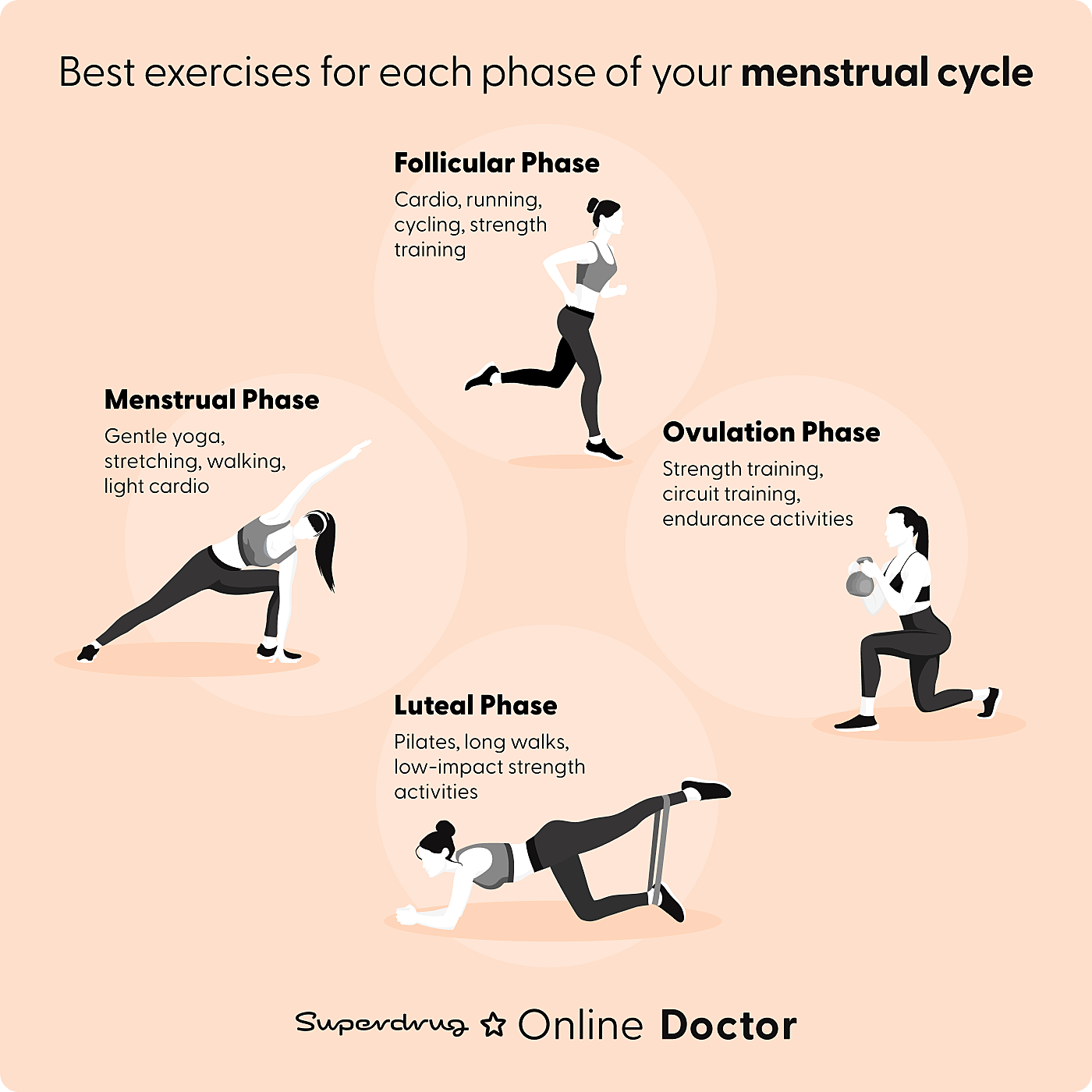
1. Exercise during the menstrual phase
Hormone levels are at their lowest at the beginning of your cycle, meaning your energy levels are likely to be low, too. During this phase, aim for low-intensity exercises which are easier on your body, do not require endurance, and are not weight-bearing, like:
- gentle yoga
- stretching
- walking
- swimming
- light cardio
Fuel your activities with carbohydrates, such as brown rice and whole wheat pasta, adequate protein from lean chicken breast, tofu, or fish, and increase your iron intake to compensate for blood loss during your period.
2. Exercise during the follicular phase
During this time, your oestrogen levels are rising, so you may notice you feel energised, have an improved mood, and are keen to work out. Now is a good time to increase the intensity of your activities and opt for:
- strength training
- high-intensity interval training (HIIT)
- cardio (running, cycling, or power walking)
It’s important that you work out safely and perform warm-ups and cool-downs, particularly as there is an increased risk of ligament injury during the follicular phase.
3. Exercise during ovulation
Studies suggest that testosterone levels peak mid-cycle at ovulation, which can influence the growth, maintenance and repair of your muscle and bone cells. At this point in your cycle, you are likely to be at your peak, so you can likely lift heavier weights and perform at high intensities.
Take advantage of this during the ovulatory phase and choose exercises such as:
- HIIT
- strength training
- circuit training
- endurance activities (like long-distance running)
4. Exercise during the luteal phase
The rise in progesterone levels during the luteal phase means you are likely to feel tired, and your body temperature will rise slightly. You may notice that you tire quickly, so it’s best to avoid endurance activities, and instead, perform low-intensity activities, such as:
- low-impact strength activities
- pilates
- moderate cardio (long walks)
During the luteal phase, your metabolism will increase, leading to cravings for carbohydrates. Choose nutritious carbohydrates that release energy slowly to help you combat fatigue. Good sources include:
- legumes
- oats
- brown rice
- quinoa
- whole wheat pasta
- wholemeal bread
Benefits of syncing your workouts with your cycle
Tailoring your workouts with your menstrual cycle may help you optimise your performance and stop you pushing yourself too hard on days where your body is not up for high-intensity exercise.
Understanding how the different phases of your menstrual cycle affect you will enable you to adjust the intensity, type of exercise, and recovery accordingly. Some of the benefits of syncing your workouts with your cycle are:
Improved performance and recovery
Understanding when you are most likely to feel energised and strong will help you optimise your routine, leading to better results. For example, when your oestrogen levels are at their highest during the follicular and ovulatory phases, you might increase the intensity of your workouts, reflecting your energy levels.
Better mood and motivation
Syncing your workouts to your cycle means you can time your routines to match how you’re feeling. For example, during the luteal phase, your energy levels are likely to be low, and you may be less motivated to work out. Opting for lower intensity activities, like yoga or walking, can have a restorative benefit and motivate you to still get some type of movement into your day.
Reduced PMS symptoms
Aligning your diet and exercise with your cycle can help you manage symptoms such as bloating, mood swings, and cravings. Low-impact activities like walking, yoga, and gentle stretching can help with menstrual cramps during the menstrual phase, while bloating and fatigue during the luteal phase may respond well to low-intensity workouts. Prioritising extra rest and recovery periods during this time will also be beneficial, as the hormonal changes are likely to leave you feeling tired.
Improved sleep
Cycle syncing can also positively benefit your sleep by aligning your workouts with the natural hormone changes taking place during your menstrual cycle. This can help support your body’s natural rhythms and hormonal shifts.
Common misconceptions about exercising on your period
There are lots of myths about working out during your period. Let’s debunk some of the common ones.
Myth #1: Working out will lighten your flow
There is no scientific evidence to suggest that exercise reduces your menstrual flow. Although it can help to manage your cramps, it does not significantly reduce the amount you bleed.
Myth #2: It’s not safe to exercise while on your period
Exercising while on your period is safe and can be beneficial for managing symptoms, such as menstrual cramps and for improving your mood. However, you should listen to your body and adjust your workout routine to suit how you are feeling.
Myth #3: Exercising will make you leak
Although exercise might make you feel like you’re menstruating more because of a faster flow, it does not increase the amount you bleed. It can cause blood to leave the womb faster, which can feel like a heavier flow, but you can combat this by keeping fresh period protection with you during exercise and using tampons, pads, menstrual cups, or period pants designed for heavier flows.
If you’re worried about leaking, wear dark clothing and, if you are exercising in a public place, bring a change of underwear and clothing to change into after your workout has finished.
Myth #4: You’re more likely to get injured
Although research suggests that there are certain points in the menstrual cycle when there is a greater chance of injury, during your period there is not one. Instead, the likelihood of picking up an injury is in the pre-menstrual and early-mid luteal phase.
Myth #5: You cannot perform on your period
Being on your period should not stop you from taking part in physical activity. Although some people may experience symptoms like mood swings, cramps, and fatigue that may affect how they feel or their energy levels, these feelings are not universal. Many people find that they are more active and can perform at higher intensities during certain phases of their cycle, including menstruation.
Tips for exercising on your period
Here are some of our top tips for exercising on your period, so you can harness the natural hormone changes taking place and optimise your performance
- Listen to your body – if any of your symptoms, like fatigue or cramps, are severe, take a rest day. If they are mild or you feel like you still want to get some movement in, gentle exercise like stretching and walking can help you feel better.
- Adapt your routine – be flexible with your workouts by prioritising low-impact exercises if you feel sluggish. If you feel energised around ovulation, take advantage of this by exercising at a higher intensity.
- Prioritise recovery – all exercise routines should prioritise recovery because it helps your body repair itself and prepares you for your next activities. Plan rest days and active recovery sessions, like stretching and foam rolling.
- Manage period hygiene – having your period should not stop you exercising, but you might consider choosing secure period products, like tampons or period pants, and wearing darker workout clothing for extra confidence. Remember, spotting during movement is normal and manageable with the right period products for your flow.
- Stay hydrated – drink water before, during, and after exercise to help keep you hydrated, and to manage symptoms like headaches and bloating.
- Make your workouts fun – choose exercises that you enjoy to help you stay motivated and consistent, especially during phases when your energy and mood may be low.
Summary
Your menstrual cycle and fluctuating hormones can affect how you feel and how much energy you have, meaning that you may have to adjust your exercise routine slightly at different stages of your cycle.
Once you understand how you feel at different points of your cycle, you can better understand what exercises work for you during this time. It’s important to do what feels good and right for you and work with your body, rather than against it.
Frequently Asked Questions
Does working out on your period burn more calories?
No, there’s no evidence to prove that exercising on your period burns more calories. Although you may experience metabolic and energy changes throughout your menstrual cycle, these are usually not significant enough to cause a noticeable difference in the number of calories you burn.
Is it safe to do HIIT during your period?
Yes, it is safe to do HIIT during your period, but the high intensity may not be the best choice during this phase of your cycle, especially if you’re experiencing cramps or fatigue. Listen to your body and choose an exercise type that suits how you feel. You may find that gentle exercises, like yoga, stretching, and walking, are preferable when working out during your period.
Can exercise regulate your menstrual cycle?
Yes, exercise can help regulate your menstrual cycle by balancing your hormones and reducing stress. However, it is important to get the balance right because excessive exercise can disrupt your cycle.
What if your cycle is irregular?
If your period is irregular, you can still try cycle syncing, but it can be more challenging and will require a more personalised approach. Begin by tracking your cycle closely by using a period tracker app or calendar to identify any patterns.
If you cannot pinpoint ovulation exactly, you may be able to estimate it based on your average cycle length or by using an ovulation testing kit. If you are finding it difficult to track your cycle, focus on how you feel and use this to guide your exercise intensity. If you are concerned about irregular periods, speak to your doctor for further advice.
Sources
- Female athletes more likely to get injured at certain points in their menstrual cycle, University College London [accessed 02 June 2025]
- Salivary testosterone across the menstrual cycle, Hormones and Behavior [accessed 02 June 2025]
- The effect of the menstrual cycle on exercise metabolism: implications for exercise performance in eumenorrhoeic women, Sports Medicine [accessed 02 June 2025]
- The Impact of Menstrual Cycle Phase on Athletes’ Performance: A Narrative Review, International Journal of Environmental Research and Public Health [accessed 02 June 2025]
- Two emerging concepts for elite athletes: the short-term effects of testosterone and cortisol on the neuromuscular system and the dose-response training role of these endogenous hormones, Sports Medicine [accessed 02 June 2025]