STIs to Go: Sex, Travel and the Testing Gap
Every summer, millions of Brits head abroad and pile into festival fields, and for a significant number, sex can be part of the trip. That's hardly a revelation, but what's less talked about is what happens to sexual health when people are away from home: the protection that doesn't get packed, the tests that don't get taken, and the symptoms that get ignored until after they get home.
We surveyed 2,000 sexually active UK adults about their experiences of sex and sexual health while travelling and attending festivals. We also combined European surveillance data on chlamydia, gonorrhoea and syphilis to map where STI rates are highest across the continent and to see whether the destinations Brits love most for a holiday fling are also the ones with the biggest sexual-health risks.
Holiday Flings, Festival Hook-Ups and Travelling for Romance
Casual sex abroad and at festivals is far more common than most people assume. Our survey shows that a majority of sexually active UK adults have had at least one encounter while away from home, and for a growing number, romance and hook-ups are actively shaping where and how they travel.
How Common Is Sex Away From Home?
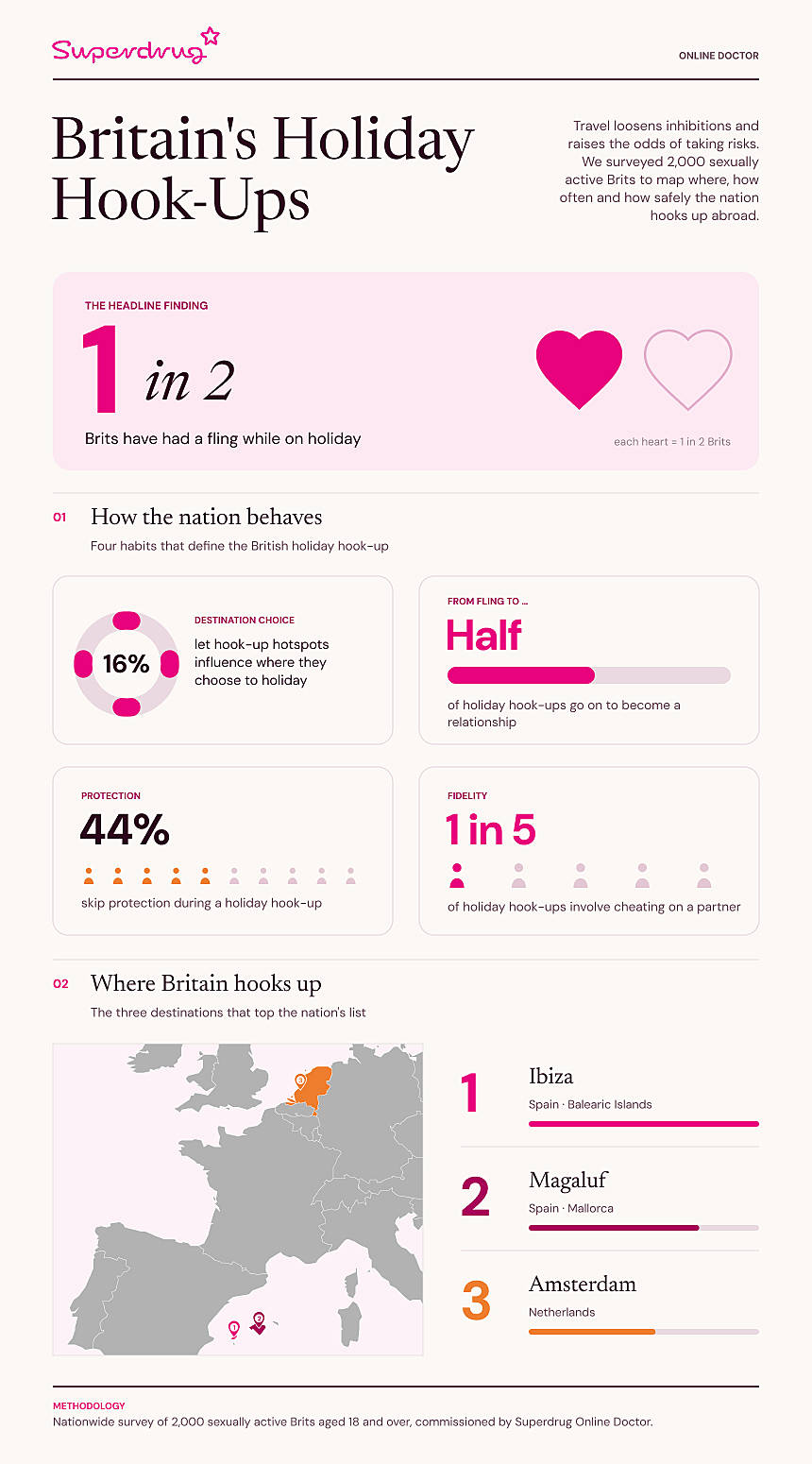
Over half of sexually active UK adults (54%) have had a casual sexual encounter while on holiday abroad, with nearly a sixth (13%) reporting this more than three times, and the 25–34 age group is the most active cohort, averaging 1.65 encounters, compared to 18-24-year-olds (1.48), 35-44-year-olds (1.44), 45-54-year-olds (1.14) and 55+ (0.93).
The data showed that activity also isn’t equal amongst the sexes, with men reporting an average of 1.65 encounters, almost double the amount of encounters (0.88) women reported.
Festivals tell a similar story. Over a third (37%) of sexually active adults have had a casual encounter at a festival, with men again more likely to report one (47% vs 25% of women).
Changing Plans for a Connection
Sex and travel are increasingly intertwined in ways that go beyond spontaneous encounters. An estimated 36% of adults have extended a trip, changed accommodation, or altered their travel plans because of a romantic or sexual connection.
16% have deliberately travelled abroad specifically for casual sex or a hook-up, a figure that rises to more than a quarter (26%) among 25–34-year-olds. And nearly 16% have chosen a destination partly because of its reputation for hook-ups, which may go some way to explaining the enduring popularity of certain party spots across Europe. This rises to 21% of men, compared to just 10% of women, showing men are more likely to head to destinations where they think they may be able to have casual sexual encounters.
What Happens After the Trip
Travel flings don't always end at the airport. Among those who've had a casual encounter on a trip or at a festival:
- 65% stayed in contact with the person after returning home
- 59% continued speaking romantically after the trip ended
- 55% met up with the person again
- 51% travelled specifically to see someone they'd hooked up with
At the other end of the scale, 46% have forgotten the name of someone they hooked up with while away, and 24% have hooked up with someone despite not speaking the same language.
Why Do We Take More Risks Away From Home, and Are We Practising Safe Sex?
Being somewhere new can change how people think about sex. Anonymity, alcohol, warm weather and a general sense of "anything goes" all play a role. The survey data show that these shifts in mindset can translate directly into lower condom use, less preparation, and more encounters where neither person knows the other's STI status.
The Disinhibition Factor
42% of adults admit they've taken greater sexual risks because they believed they would never see the other person again. While 25–34-year-olds are the most sexually active age group, 18–24-year-olds are the most likely to engage in risky sexual behaviour.
That sense of anonymity feeds into real behaviour: 43% of people who've had casual sex abroad were under the influence of alcohol at the time. Alcohol can lower inhibitions and impair decision-making, potentially increasing the likelihood of unprotected sex and other risky behaviours.
Holiday vs Festival: Different Settings, Different Drivers
People associate sexual risk-taking on holiday with very different factors than they do at festivals. On holiday, risks are more often linked to the environment itself, warm weather and the holiday mindset (40%), being away from home and feeling anonymous (30%), language barriers (42%), and worries about accessing or paying for healthcare abroad (23%).
Festival-associated drivers skew towards substance use and logistics. Our survey showed that recreational drugs are more strongly linked to festivals (30% vs 13% for holidays), along with party atmosphere (26% vs 17%) and lack of access to protection (22% vs 18%).
Alcohol is seen as equally likely to drive risk in both settings, with 47% saying it's associated with both.
The Protection Gap
44% of adults have had sex without protection while away from home on a trip. At festivals, the figure is 27%. The 25–34 age group – the same cohort having the most sex while travelling – has the highest rate of unprotected holiday sex at 58%, followed closely by 35–44-year-olds at 52%.
Preparation tells its own story. 48% of sexually active adults pack condoms or protection before travelling, but 41% do not. For festivals, the gap widens: only 34% pack protection, while 49% don't.
Men are significantly more likely to pack condoms than women, despite the fact that the responsibility for contraception often already falls disproportionately on women through methods such as the pill, IUD and Depo-Provera (depo) injection. Nearly six in ten men (59%) say they pack protection when travelling, compared to just 34% of women, while 44% pack condoms for festivals, versus 23% of women.
Sex Without Knowing Their Status
Nearly a third of adults have had sex with someone whose STI status they didn't know while travelling, rising to 41% among men and peaking at 40% among 25–34-year-olds. The consequences are real: 13% of those who had a casual encounter abroad reported contracting an STI as a result, a figure that rises to nearly one in five (20%) among those who hooked up at a festival.
Combined with low condom use and limited testing (covered below), this creates a significant window of undetected risk, particularly in destinations where navigating local healthcare isn't straightforward.
Global STI Hotspots - Do Holiday Hotspots Match STI Risk?
Ibiza, Magaluf and Amsterdam top the list of destinations Brits associate with casual flings. But are the places people go to hook up also the places with the highest STI rates?
We mapped European surveillance data across 37 countries to find out. The answer is more nuanced than you might expect.
The Destinations Brits Associate With Hook-Ups
When asked which European destinations they most associate with casual flings, the UK's top five are firmly in party-holiday territory:
- Ibiza: 38%
- Magaluf: 28%
- Amsterdam: 18%
- Ayia Napa: 18%
- Benidorm: 17%
Party holidays dominate the types of trips most associated with hook-ups (40%), followed by stag dos (30%), festivals abroad (25%), and hen dos (24%).
The European STI Risk Rankings
Although party destinations like Ibiza and Magaluf have a reputation for one-night stands and casual encounters, according to Brits, these destinations do not fall within the countries reporting the highest numbers of STIs.
Using 2024 surveillance data from the European Centre for Disease Prevention and Control (ECDC), we combined rates of chlamydia, gonorrhoea and syphilis across 37 European countries and territories to produce a combined STI rate per 100,000 people.
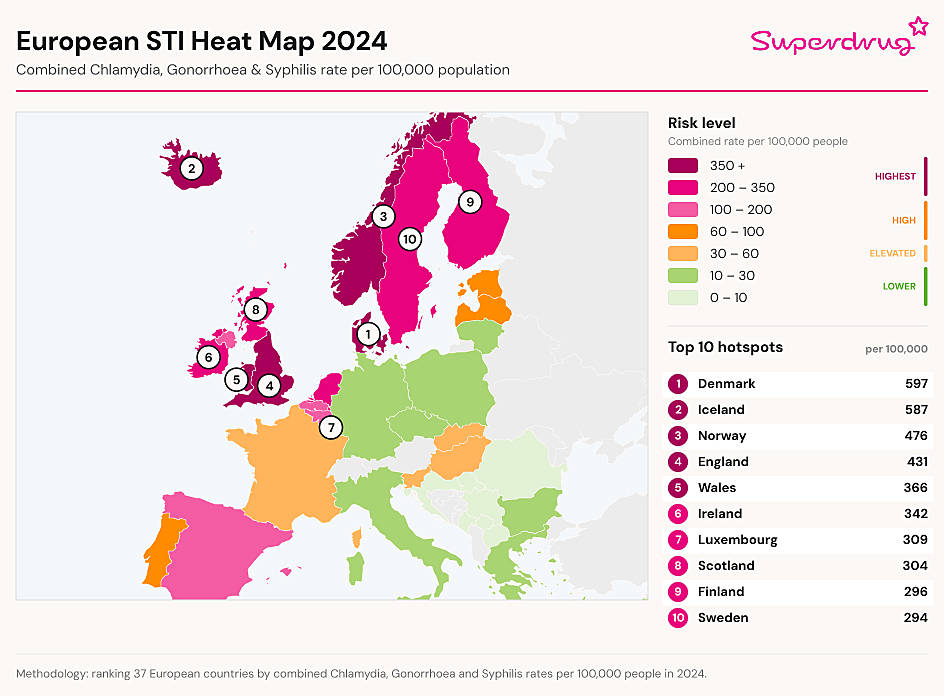
The five countries with the highest combined STI rates in Europe are Denmark (597 per 100,000), Iceland (587), Norway (476), England (431) and Wales (366). Denmark's position is driven largely by chlamydia, where it has the highest rate on the continent (501 per 100,000). England, meanwhile, has the highest gonorrhoea rate in Europe (126 per 100,000), more than any other country by a significant margin. Malta, while 11th overall for combined rate, has Europe's highest syphilis rate (60 per 100,000), more than double the next highest country.
It's important to note that higher STI rates may partly reflect greater access to testing and more robust reporting systems, meaning countries with strong sexual health services can sometimes appear higher in the rankings than countries where infections are underdiagnosed or underreported.
What the Rankings Tell Us
England ranks fourth in Europe for combined STI rate, higher than any of the holiday destinations Brits most associate with casual flings. Spain (home to Ibiza, Magaluf and Benidorm) sits at 13th with a combined rate of 186 per 100,000, and the Netherlands (Amsterdam) at 12th with 202 per 100,000. Both are well below the UK.
Cyprus, home to Ayia Napa, sits at 31st with a combined rate of just 10 per 100,000, though country-wide figures don't necessarily reflect what's happening in specific resort towns during peak season.
The findings highlight that Brits shouldn't assume they are protected from sexual health risks simply because a destination doesn't have a reputation as a hook-up hotspot. The reality is that the risk associated with casual sex is shaped less by geography and more by individual behaviour. Lowered inhibitions, inconsistent condom use and failing to get tested after returning home can all increase the likelihood of STI transmission, regardless of whether someone is in a well-known party destination or a seemingly low-risk location. The message is clear: if you're consenting to engage in casual sex, it's important to remain vigilant about protection and testing, no matter where your travels take you.
Trending Upwards

STI rates are rising rapidly across parts of Europe, with Bulgaria seeing a +278% rise in chlamydia cases. Malta saw syphilis cases surge by 174% year-on-year, while gonorrhoea cases jumped 160% in Kosovo and more than doubled in Lithuania (+103%). Lithuania also recorded a 77% rise in syphilis, with Bulgaria (+91%) and Serbia (+59%) seeing sharp gonorrhoea increases.
Festival Hook-Up Hotspots and Post-Festival Healthcare Trends
Festivals create their own dynamic when it comes to sexual health. Thousands of people, limited facilities, a rise in alcohol consumption, and a collective sense that normal rules don't apply. The survey data shows which festivals are most associated with hook-ups, and our own ordering data reveals what happens to sexual-health demand once the music stops.
Which Festivals Are Most Associated With Hook-Ups?
The survey reveals a clear hierarchy on the UK festival circuit:
- Glastonbury: 32%
- Creamfields: 17%
- Reading & Leeds: 15%
- Isle of Wight: 13%
- Wireless: 12%
Glastonbury dominates, which probably reflects its scale and the fact that tens of thousands of people spend several days in close proximity as much as anything else.
Post-Festival Healthcare Spikes
The survey tells us what people say they do. Our own ordering data from summer 2025 shows what they actually do afterwards. The patterns are consistent and telling.
June kicks off the festival season with Download (13–15 June), Isle of Wight (19–22 June) and Glastonbury (25–29 June), and the ordering data reflects it. Emergency contraception orders run above the rest of the year throughout the month, particularly compared to the first half. STI test orders spike sharply in the last week of June, up 30% over the non-summer baseline. Demand for chlamydia treatment grows steadily and peaks immediately after Glastonbury, with an 18% increase over baseline.
The pattern continues into July, when Wireless and TRNSMT (both 11–13 July) trigger their own healthcare response. Emergency contraception orders see an immediate post-festival spike of +22% versus baseline in the week commencing 14 July. STI test orders follow about two weeks later, rising 19% versus baseline in the week commencing 28 July. That two-week lag is consistent with people waiting the recommended testing window before getting checked.
August brings the biggest spikes of the year, driven by Boardmasters and Boomtown Fair (both 6–10 August), followed by Reading & Leeds and Creamfields (both 21–24 August). The late-August cluster coincides with the highest emergency contraception spike of the year, 33% above baseline in the week commencing 25 August. STI test orders rise +21% in the first week of September, and chlamydia testing follows with a +17% increase in the same period.
Across the entire summer, the same cycle repeats: a sharp rise in emergency contraception orders immediately after each festival block, followed by an STI testing spike roughly two weeks later, tracking the clinical window period for reliable chlamydia and gonorrhoea detection.
The Testing Gap - What Gets in the Way of Seeking Help?
If people are having more casual sex while travelling and using less protection when they do, the logical safety net is testing – before the trip, after the trip, or both. But the survey shows that testing rates are low across the board and that a significant number of people are actively avoiding tests even when they're worried something might be wrong.
Low Baseline Testing Rates
Only about one in five (21%) sexually active adults have ever taken an STI test before travelling. Pre-festival testing is similarly low at 18%. In practical terms, nearly four in five people head off without knowing their current STI status.
Testing rates are highest among 25–34-year-olds (37% before travel), which makes sense given they're also the most sexually active group. But even among that cohort, roughly two-thirds haven't tested before a trip. Men are more likely than women to prepare for safer sex before travelling, with 27% getting tested (vs 14% of women) and higher rates of packing protection, aligning with their greater likelihood of sexual activity abroad.
Among those who've had a casual sexual encounter on a trip, only 40% have taken an STI test after returning home. Post-festival testing is somewhat higher at 48%. The 25–34 age group shows the highest post-trip testing rate at 61%, but that still leaves nearly four in ten in the most active group going untested after a casual encounter abroad.
Concern Without Action
One of the survey's most striking findings is the gap between worrying about STIs and actually getting tested. Among those who've had casual sex on holiday, 19% actively avoided getting tested, despite having concerns afterwards. After festival encounters, that figure rises to 27%.
This avoidance is sharpest among younger adults. Among 25–34-year-olds, 31% avoided a post-trip test and 36% avoided a post-festival test despite having concerns. And among those who had unprotected sex while abroad, 18% ignored STI symptoms until after returning home, a figure that's consistent across genders but peaks among 25–34-year-olds (26%) and Londoners (27%).
Barriers to Seeking Help Abroad
Roughly two-thirds (65%) of adults say they would be likely to seek medical advice abroad if they thought they'd contracted an STI. But for the significant minority who wouldn't, practical barriers play a real role:
- 15% have avoided seeking sexual health support abroad due to embarrassment
- 16% have avoided it due to cost concerns
- One in five (20%) have looked up local sexual health services while abroad, rising to 35% among 25–34-year-olds
The reality is that navigating an unfamiliar healthcare system while dealing with embarrassment and potential language barriers is daunting, and many people simply put it off until they get home. At-home STI test kits can fill that gap, letting you get tested discreetly once you're back. And if you do test positive for something like chlamydia, services like Superdrug Online Doctor can provide prescriptions and treatment without needing a face-to-face appointment.
Doctor's Advice: Staying Safe While You're Away
Dr Clair Grainger, GP at Superdrug Online Doctor, shares practical guidance on protecting your sexual health while travelling or at festivals.
1. Pack condoms. It sounds obvious, but the survey data shows that more than four in ten people don't, and at festivals, fewer than one in three do. Condoms are still the only effective way to reduce your risk of STIs during casual sex, and they're easy to overlook when you're packing for a trip.
2. If you're sexually active with new partners while you're away, the key thing to be aware of is testing windows. Most common STIs, including chlamydia and gonorrhoea, can be reliably detected from around two weeks after exposure. For HIV, you'll want to wait at least 45 days, and for syphilis, anywhere from six to twelve weeks. Testing too early can produce a false negative, which can be worse than not testing at all because it gives you false reassurance. Mark the date in your phone and test when the window has passed.
3. It's also worth remembering that many STIs are asymptomatic. Chlamydia often causes no symptoms whatsoever, but left untreated, it can lead to pelvic inflammatory disease and fertility problems. Feeling fine isn't the same as being clear, which is why testing matters even when nothing seems wrong.
4. If you think you've been exposed to something while abroad, don't wait. Many countries have walk-in sexual health clinics, and pharmacies can often point you in the right direction. If you'd rather not navigate a local healthcare system, at-home test kits are another option. Once you're back, you can take samples privately and get results within a few days of the lab receiving them. If you test positive for chlamydia, treatment is usually a short course of antibiotics like doxycycline, which can be prescribed through an online consultation. If you are concerned about any potential exposures or have any new symptoms you can also contact your GP or sexual health clinic for review.
5. It's worth having a conversation with any new partner about sexual health, even if you're planning to use a condom. Condoms significantly reduce your risk of most STIs, but they don't cover everything. Infections like herpes and syphilis can be passed through skin-to-skin contact, which a condom doesn't protect against. A quick, honest check-in about when you were both last tested doesn't have to be awkward, and it's one of the simplest ways to look after yourself and the other person.
Don't let a holiday or festival be followed by weeks of anxiety when a test and a conversation with a doctor could sort things out quickly.
Methodology
Survey Methodology
Survey findings are based on a nationally representative survey of 2,002 sexually active UK adults (aged 18+), commissioned by Superdrug Online Doctor and conducted by Censuswide between 22–27 May 2026. The survey explored sexual behaviour, sexual-health attitudes and STI-related experiences while travelling and attending festivals. Censuswide is a member of the Market Research Society (MRS) and the British Polling Council (BPC), and a signatory of the Global Data Quality Pledge.
Superdrug Online Doctor Proprietary Data
Superdrug Online Doctor proprietary data analysed ordering trends for emergency contraception, STI tests and chlamydia treatment across major UK festival periods in 2025, comparing demand against non-summer baseline levels to identify seasonal spikes and post-festival healthcare behaviour.
European STI Rates Methodology
European STI rates are based on 2024 surveillance data from the European Centre for Disease Prevention and Control (ECDC). Country-level rates per 100,000 population were normalised against the highest European rate for each disease (chlamydia, gonorrhoea and syphilis) and averaged to create a combined STI risk score out of 100. Risk levels were categorised as High (33+), Medium (12–32) and Low (under 12). UK nations were reported separately in line with ECDC methodology. Where data was unavailable for a specific infection, a rate of zero was applied to combined-score calculations.